
Arthur Gray Arthur Gray
0 Course Enrolled • 0 Course CompletedBiography
JN0-351 Test Answers & Cost Effective JN0-351 Dumps
The JN0-351 quiz torrent we provide is compiled by experts with profound experiences according to the latest development in the theory and the practice so they are of great value. Please firstly try out our product before you decide to buy our product. It is worthy for you to buy our JN0-351 Exam Preparation not only because it can help you pass the JN0-351 exam successfully but also because it saves your time and energy. Your satisfactions are our aim of the service and please take it easy to buy our JN0-351 quiz torrent.
Juniper JN0-351 Exam Syllabus Topics:
| Topic | Details |
|---|---|
| Topic 1 |
|
| Topic 2 |
|
| Topic 3 |
|
| Topic 4 |
|
| Topic 5 |
|
Cost Effective JN0-351 Dumps - Free JN0-351 Pdf Guide
JN0-351 eaxm dumps at PassLeaderVCE are always kept up to date. Every addition or subtraction of JN0-351 exam dumps in the exam syllabus is updated in our brain dumps instantly. Practice on real JN0-351 exam dumps and we have provided their answers too for your convenience. If you put just a bit of extra effort, you can score the highest possible score in the Real JN0-351 Exam because our JN0-351 exam preparation dumps are designed for the best results.
Juniper Enterprise Routing and Switching, Specialist (JNCIS-ENT) Sample Questions (Q49-Q54):
NEW QUESTION # 49
Exhibit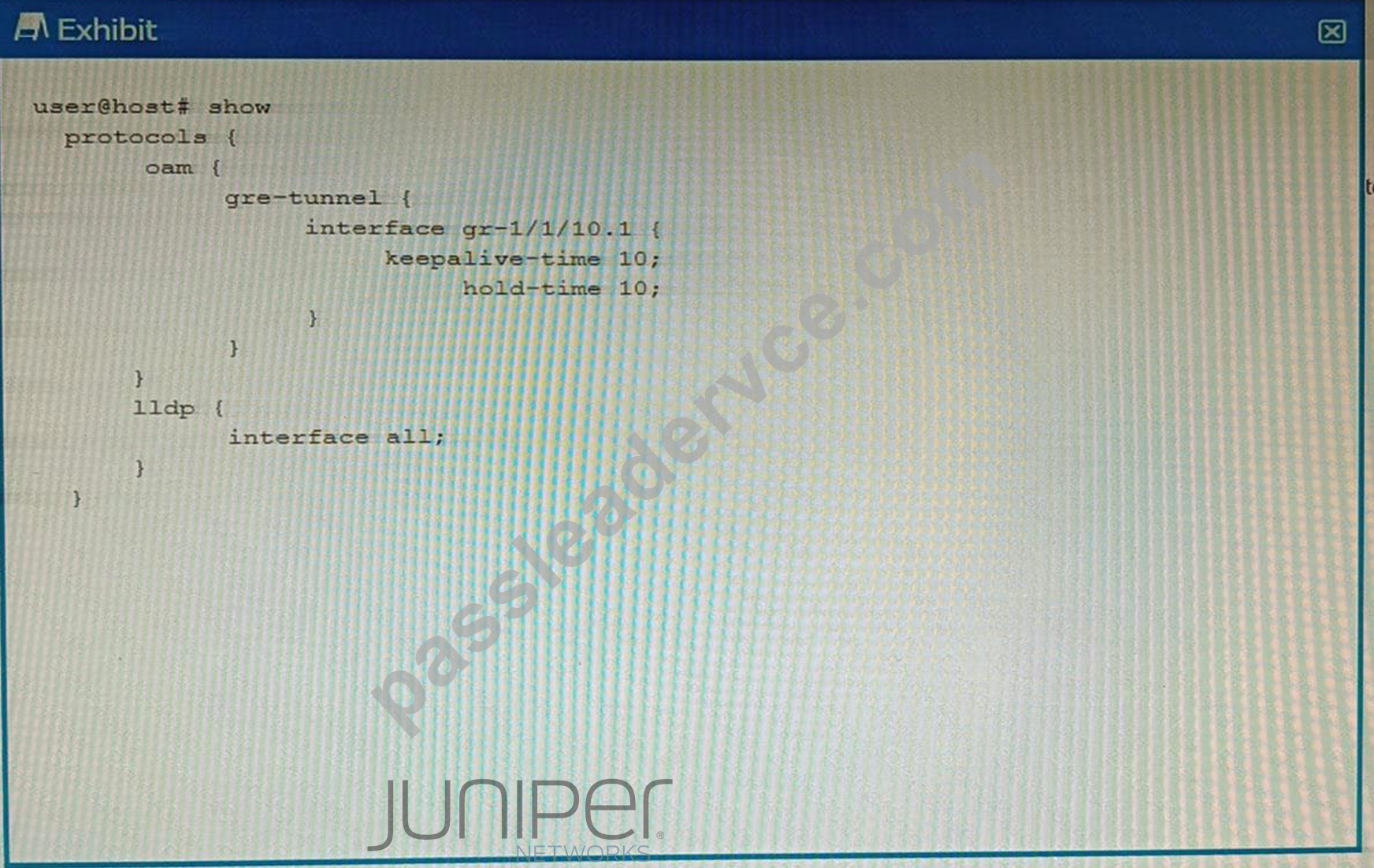
You have configured a GRE tunnel. To reduce the risk of dropping traffic, you have configured a keepalive OAM probe to monitor the state of the tunnel; however, traffic drops are still occurring.
Referring to the exhibit, what is the problem?
- A. LLDP needs to be removed from the gr-1/1/10.1 interface.
- B. The hold-time value must be two times the keepalive-time value
- C. For GRE tunnels, the OAM protocol requires that the BFD protocols also be used.
- D. The "event link-adjacency-loss" option must be set.
Answer: B
Explanation:
Explanation
A keepalive OAM probe is a mechanism that can be used to monitor the state of a GRE tunnel and detect any failures in the tunnel path. A keepalive OAM probe consists of sending periodic packets from one end of the tunnel to the other and expecting a reply. If no reply is received within a specified time, the tunnel is considered down and the line protocol of the tunnel interface is changed to down1.
To configure a keepalive OAM probe for a GRE tunnel, you need to specify two parameters: the keepalive-time and the hold-time. The keepalive-time is the interval between each keepalive packet sent by the local router. The hold-time is the maximum time that the local router waits for a reply from the remote router before declaring the tunnel down2.
According to the Juniper Networks documentation, the hold-time value must be two times the keepalive-time value for a GRE tunnel2. This is because the hold-time value must account for both the round-trip time of the keepalive packet and the processing time of the remote router. If the hold-time value is too small, it may cause false positives and unnecessary tunnel flaps.
In the exhibit, the configuration shows that the keepalive-time is set to 10 seconds and the hold-time is set to
15 seconds for the gr-1/1/10.1 interface. This means that the local router will send a keepalive packet every 10 seconds and will wait for 15 seconds for a reply from the remote router. However, this hold-time value is not two times the keepalive-time value, which violates the recommended configuration. This may cause traffic drops if the remote router takes longer than 15 seconds to reply.
Therefore, option D is correct, because the hold-time value must be two times the keepalive-time value for a GRE tunnel. Option A is incorrect, because BFD is not required for GRE tunnels; BFD is another protocol that can be used to monitor tunnels, but it is not compatible with GRE keepalives3. Option B is incorrect, because the "event link-adjacency-loss" option is not related to GRE tunnels; it is an option that can be used to trigger an action when a link goes down4. Option C is incorrect, because LLDP does not need to be removed from the gr-1/1/10.1 interface; LLDP is a protocol that can be used to discover neighboring devices and their capabilities, but it does not interfere with GRE tunnels5.
References:
1: Configuring Keepalive Time and Hold time for a GRE Tunnel Interface 2: keepalive | Junos OS | Juniper Networks 3: Configuring Bidirectional Forwarding Detection 4: event link-adjacency-loss | Junos OS | Juniper Networks 5: Understanding Link Layer Discovery Protocol
NEW QUESTION # 50
Exhibit.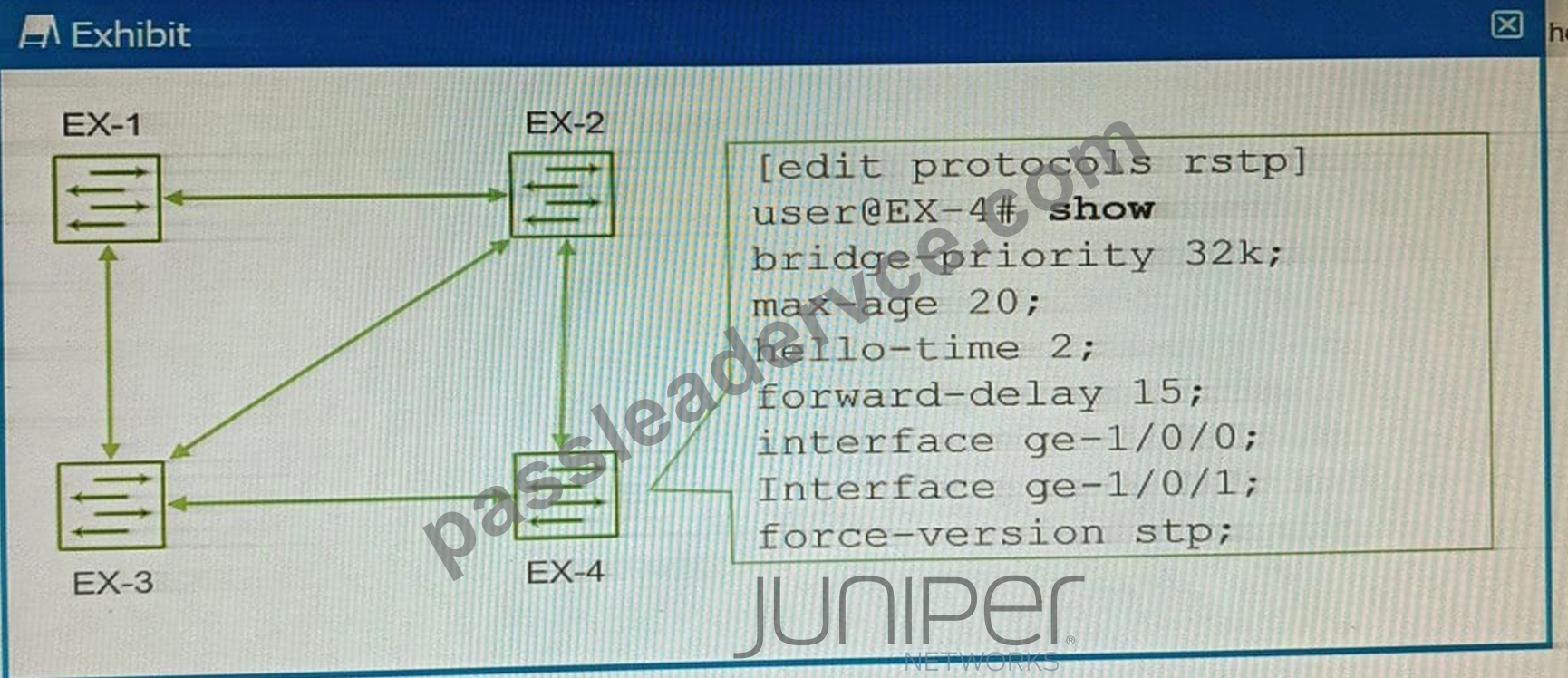
You have configured the four EX Series switches with RSTP, as shown in the exhibit. You discover that whenever a link between switches goes up or down, the switches take longer than expected for RSTP to converge, using the default settings.
In this scenario, which action would solve the delay in RSTP convergence?
- A. The max-age must be increased to 20
- B. The bridge priority for EX-4 must be set at 4000.
- C. The force-version must be removed.
- D. The hello-time must be increased.
Answer: C
Explanation:
The exhibit shows the configuration of RSTP on EX-4, which has the command force-version stp. This command forces the switch to use the legacy STP protocol instead of RSTP, even though the switch supports RSTP1. This means that EX-4 will not be able to take advantage of the faster convergence and enhanced features of RSTP, such as edge ports, link type, and proposal/agreement sequence2.
The other switches in the network are likely to be running RSTP, as it is the default protocol for EX Series switches3. Therefore, there will be a compatibility issue between EX-4 and the other switches, which will result in longer convergence times and suboptimal performance. The switch will also generate a warning message that says "Warning: STP version mismatch with neighbor" when it receives a BPDU from a RSTP neighbor1.
To solve this problem, the force-version command must be removed from EX-4, so that it can run RSTP natively and interoperate with the other switches in the network. This will enable faster convergence and better stability for the network topology. To remove the command, you can use the delete protocols rstp force-version command in configuration mode1.
NEW QUESTION # 51
What are two reasons for creating multiple areas in OSPF? (Choose two.)
- A. to reduce the convergence time
- B. to increase the number of adjacencies in the backbone
- C. to reduce LSA flooding across the network
- D. to increase the size of the LSDB
Answer: A,C
Explanation:
Explanation
Option A is correct. Creating multiple areas in OSPF can help to reduce the convergence time . This is because changes in one area do not affect other areas, so fewer routers need to run the SPF algorithm in response to a change.
Option D is correct. Creating multiple areas in OSPF can help to reduce Link State Advertisement (LSA) flooding across the network. This is because LSAs are not flooded out of their area of origin.
NEW QUESTION # 52
You are asked to create a new firewall filter to evaluate Layer 3 traffic that is being sent between VLANs. In this scenario, which two statements are correct? (Choose two.)
- A. You should apply the firewall filter to the appropriate IRB interface.
- B. You should apply the firewall filter to the appropriate VLAN.
- C. You should create a family inet firewall filter with the appropriate match criteria and actions.
- D. You should create a family Ethernet-switching firewall filter with the appropriate match criteria and actions.
Answer: A,C
Explanation:
Explanation
A firewall filter is a configuration that defines the rules that determine whether to forward or discard packets at specific processing points in the packet flow. A firewall filter can also modify the attributes of the packets, such as priority, marking, or logging. A firewall filter can be applied to various interfaces, protocols, or routing instances on a Juniper device1.
A firewall filter has a family attribute, which specifies the type of traffic that the filter can evaluate. The family attribute can be one of the following: inet, inet6, mpls, vpls, iso, or ethernet-switching2. The family inet firewall filter is used to evaluate IPv4 traffic, which is the most common type of Layer 3 traffic on a network.
To create a family inet firewall filter, you need to specify the appropriate match criteria and actions for each term in the filter. The match criteria can include various fields in the IPv4 header, such as source address, destination address, protocol, port number, or DSCP value. The actions can include accept, discard, reject, count, log, policer, or next term3.
To apply a firewall filter to Layer 3 traffic that is being sent between VLANs, you need to apply the filter to the appropriate IRB interface. An IRB interface is an integrated routing and bridging interface that provides Layer 3 functionality for a VLAN on a Juniper device. An IRB interface has an IP address that acts as the default gateway for the hosts in the VLAN. An IRB interface can also participate in routing protocols and forward packets to other VLANs or networks4.
Therefore, option C is correct, because you should create a family inet firewall filter with the appropriate match criteria and actions. Option D is correct, because you should apply the firewall filter to the appropriate IRB interface.
Option A is incorrect, because you should not create a family ethernet-switching firewall filter with the appropriate match criteria and actions. A family ethernet-switching firewall filter is used to evaluate Layer 2 traffic on a Juniper device. A family ethernet-switching firewall filter can only match on MAC addresses or VLAN IDs, not on IP addresses or protocols5.
Option B is incorrect, because you should not apply the firewall filter to the appropriate VLAN. A VLAN is a logical grouping of hosts that share the same broadcast domain on a Layer 2 network. A VLAN does not have an IP address or routing capability. A firewall filter cannot be applied directly to a VLAN; it must be applied to an interface that belongs to or connects to the VLAN6.
References:
1: Firewall Filters Overview 2: Configuring Firewall Filters 3: Configuring Firewall Filter Match Conditions and Actions 4: Understanding Integrated Routing and Bridging Interfaces 5: Configuring Ethernet-Switching Firewall Filters 6: Understanding VLANs
NEW QUESTION # 53
Which two statements are true about the default VLAN on Juniper switches? (Choose two.)
- A. The default VLAN ID is not visible.
- B. The default VLAN ID is not assigned to any interface.
- C. The default VLAN ID can be changed.
- D. The default VLAN is set to a VLAN ID of 1 by default
Answer: C,D
Explanation:
Explanation
On Juniper switches, the default VLAN is set to a VLAN ID of 1 by default12. This means that all interfaces on the switch are members of VLAN 1 until they are specifically assigned to another VLAN12. Therefore, option A is correct.
The default VLAN ID can be changed12. This allows network administrators to configure the switch to use a different VLAN as the default, if necessary12. Therefore, option D is correct.
NEW QUESTION # 54
......
Our company has occupied large market shares because of our consistent renovating on the JN0-351 exam questions. We have built a powerful research center and owned a strong team to do a better job on the JN0-351 training guide. Up to now, we have got a lot of patents about our JN0-351 Study Materials. On the one hand, our company has benefited a lot from renovation. Customers are more likely to choose our products. On the other hand, the money we have invested is meaningful, which helps to renovate new learning style of the JN0-351 exam.
Cost Effective JN0-351 Dumps: https://www.passleadervce.com/JNCIS-ENT/reliable-JN0-351-exam-learning-guide.html
- Professional Juniper Test Answers – Reliable Cost Effective JN0-351 Dumps 🌈 Copy URL ⇛ www.testkingpdf.com ⇚ open and search for 「 JN0-351 」 to download for free 😇Latest JN0-351 Test Guide
- Quiz Juniper - Professional JN0-351 - Enterprise Routing and Switching, Specialist (JNCIS-ENT) Test Answers 🐶 Search for ⇛ JN0-351 ⇚ and download exam materials for free through ☀ www.pdfvce.com ️☀️ 📂Latest JN0-351 Exam Camp
- Practice JN0-351 Exams Free 🥿 Latest JN0-351 Test Guide 🏬 JN0-351 Exam Quizzes 🔝 Search for ➽ JN0-351 🢪 on 《 www.passtestking.com 》 immediately to obtain a free download 🧾Cheap JN0-351 Dumps
- Efficient JN0-351 Test Answers - Leading Offer in Qualification Exams - Free PDF Juniper Enterprise Routing and Switching, Specialist (JNCIS-ENT) ♿ Search for ⏩ JN0-351 ⏪ and obtain a free download on 【 www.pdfvce.com 】 🍘JN0-351 Exam Quizzes
- 100% Pass Quiz 2025 Juniper JN0-351: Enterprise Routing and Switching, Specialist (JNCIS-ENT) Authoritative Test Answers 🚡 Immediately open ▛ www.pass4test.com ▟ and search for ( JN0-351 ) to obtain a free download ▛Practice JN0-351 Exam
- JN0-351 Test Answers - Quiz 2025 Juniper Realistic Cost Effective Enterprise Routing and Switching, Specialist (JNCIS-ENT) Dumps 🍒 Simply search for ➠ JN0-351 🠰 for free download on 《 www.pdfvce.com 》 🙇JN0-351 Answers Free
- JN0-351 Answers Free 🪕 JN0-351 Exam Quizzes 🦢 Latest JN0-351 Test Guide 🛃 Search for ✔ JN0-351 ️✔️ on ➥ www.exam4pdf.com 🡄 immediately to obtain a free download 🕘JN0-351 Test Cram Pdf
- High JN0-351 Passing Score 🔰 Dumps JN0-351 Questions 🚀 Valid JN0-351 Test Guide ⏏ Copy URL ⮆ www.pdfvce.com ⮄ open and search for ⮆ JN0-351 ⮄ to download for free ⬅Cheap JN0-351 Dumps
- JN0-351 Question Dumps Keep the High Accuracy of Enterprise Routing and Switching, Specialist (JNCIS-ENT) Exam - www.lead1pass.com 🍰 Download ➠ JN0-351 🠰 for free by simply entering 《 www.lead1pass.com 》 website 📅High JN0-351 Passing Score
- Efficient JN0-351 Test Answers - Leading Offer in Qualification Exams - Free PDF Juniper Enterprise Routing and Switching, Specialist (JNCIS-ENT) ⛲ Download “ JN0-351 ” for free by simply entering [ www.pdfvce.com ] website 🤭JN0-351 New Braindumps
- Latest JN0-351 Test Guide 🔪 Latest JN0-351 Test Guide 🔔 Latest JN0-351 Exam Camp 👭 Search for 「 JN0-351 」 and download it for free immediately on ➤ www.prep4pass.com ⮘ 🚵Latest JN0-351 Exam Camp
- JN0-351 Exam Questions
- learning.cpdwebdesign.com bacsihoangoanh.com emanubrain.com learn-step.com elearning.corpacademia.com staging.discipleonscreen.com taqaddm.com theliteracysphere.com libstudio.my.id daninicourse.com